

Showing posts with label Diving. Show all posts
Showing posts with label Diving. Show all posts
Thursday, January 17, 2013

Wednesday, June 27, 2012
Immersed Senses

Improving the limitations of current scuba diving system, designer Adam Wendel has come up with a futuristic device named the “Immersed Senses” that changes the way the diver sees, hears, and breathes underwater, allowing them to become a part of their surrounding environment. Immersed Senses is the future of underwater diving and exploration. Featuring a LED flashlight to let the diver to observe the dark depths of the ocean, the mask also includes a large OLED glass display to offer a panoramic view of the surroundings. The OLED enclosed helmet also allows the extracted oxygen to flow freely throughout the helmet, as if you are breathing on land without any breathing apparatus.

While an interactive OLED display gives access to underwater GPS maps, therefore allowing the diver to navigate efficiently throughout the ocean’s landscapes. The OLED also offers software that can identify all species of fish, coral and other ocean dwelling creatures that diver is currently viewing. With Immersed Senses, experiencing the underwater world is now fully interactive. In addition, the OLED screen depicts important info such as oxygen toxicity, nitrogen levels and even body heat to keep the diver well informed and safe.
Made in haptic glass, the device concept touts futuristic technology to the core. An optically clear glass with microscopic pours keeps water molecules out, yet it allows sound waves to pass through. Sound travels six times faster underwater than on land, however it is nearly impossible to interpret where the sound is coming from. The haptic glass interprets the sound wave orientation then displays the source and direction on the OLED display.
Water leakage is eliminated with the use of a silicone lining that seals the helmet to the skin. The silicone’s flexibility affords the diver to explore with comfortable movements. The orange side panels assist in internal circulation of the extracted oxygen. The rear of the helmet contains an electrolysis reactor that extracts oxygen from saltwater. The breathable oxygen is circulated throughout the helmet, creating a revolutionary underwater breathing experience.
Immersed Senses operates by a battery that utilizes a centrifuge mechanism to pull oxygen from seawater that begins the electrolysis reaction. Saltwater is extracted into the bottom reservoir that reacts with hydrogen gas. The saltwater is then charged by a positive and negative anode/cathode that generates breathable oxygen. Two internal devices help to circulate the oxygen to the diver’s mouth and nose.
The diver then breathes in the oxygen and out carbon dioxide, which exits the helmet. The battery and stored hydrogen can keep a diver submersed for up to 8 hours. The Immersed Senses revolutionizes how a human can breathe underwater, as well as interact with the OLED display offering a panoramic view of the deep sea.
Made in haptic glass, the device concept touts futuristic technology to the core. An optically clear glass with microscopic pours keeps water molecules out, yet it allows sound waves to pass through. Sound travels six times faster underwater than on land, however it is nearly impossible to interpret where the sound is coming from. The haptic glass interprets the sound wave orientation then displays the source and direction on the OLED display.
Water leakage is eliminated with the use of a silicone lining that seals the helmet to the skin. The silicone’s flexibility affords the diver to explore with comfortable movements. The orange side panels assist in internal circulation of the extracted oxygen. The rear of the helmet contains an electrolysis reactor that extracts oxygen from saltwater. The breathable oxygen is circulated throughout the helmet, creating a revolutionary underwater breathing experience.
Immersed Senses operates by a battery that utilizes a centrifuge mechanism to pull oxygen from seawater that begins the electrolysis reaction. Saltwater is extracted into the bottom reservoir that reacts with hydrogen gas. The saltwater is then charged by a positive and negative anode/cathode that generates breathable oxygen. Two internal devices help to circulate the oxygen to the diver’s mouth and nose.
The diver then breathes in the oxygen and out carbon dioxide, which exits the helmet. The battery and stored hydrogen can keep a diver submersed for up to 8 hours. The Immersed Senses revolutionizes how a human can breathe underwater, as well as interact with the OLED display offering a panoramic view of the deep sea.
Monday, June 11, 2012
Sexy Diver - Jessica Alba

Do you want to be a sexy diver? Need to get fit? Now we have the reason why Jessica Alba looks like this. So how can you become the next Jessica Alba thanks to Scuba Diving…
Think of the amount of calories you loose while scuba diving.
Here we go:
Shapely legs: Swimming with fins (flippers) is like water-based weight-training – firming the front of the thighs as you kick down and the back of the thighs as you kick up. 4 stars
Weight loss: Surprisingly good for burning energy. Someone weighing approximately 70kg (11st) burns 13 calories a minute while scuba diving, so a 45-minute dive would use 585 calories. 3 stars
Cardiorespiratory fitness: According to the British Thoracic Society, scuba divers tend to have larger-than-average lungs and an increased vital capacity (the maximum volume of air exhaled after inhalation). 4 stars
Upper-body strength: The back, shoulders and arms get a certain amount of work lugging around equipment, but once in the water, the upper body gets off lightly. Arms are usually folded across the chest or kept by the sides. 2 stars
Convenience: Even if you decide to dive in the Australia, it’s still an equipment-heavy, location-specific, expensive sport that requires a licence, and therefore tuition. 1 star
Friday, June 8, 2012
Scuba Pro's Meridian Dive Computer
 SCUBAPRO’s Meridian combines a classy timepiece with an advanced dive computer. The housing is made of marine grade 316-L stainless-steel with a two-toned brushed finish. The display uses bold digits and icons, and is flanked by four control buttons for navigating through the system. A full-featured wristwatch on the surface, when it comes time to hit the water the Meridian lets you choose between Scuba, Apnea or Gauge modes. All modes use an eye-pleasing reverse display backlight and can be equipped with optional heart rate monitors. After the dive, profiles and other data can be downloaded using SCUBAPRO’s LogTrak software, compatible with both the latest versions of Windows and Mac. Bottom Line: As a luxury watch and muscular data cruncher, the Meridian offers state-of-the-art performance, both under water and on the surface.
 For more information:
http://www.scubapro.com
Find this product at your local SCUBAPRO dealer
NSW Acts to Protect Hammerhead Sharks

New South Wales Australia is heading an effort to save two species of hammerhead shark from extinction.
The NSW government has passed legislation to protect the great and scalloped hammerhead sharks in NSW waters, two species whose numbers are being endangered by local fishing and an appetite for shark fin soup.
An ammendment to the Fisheries Management Act 1994 lists the great hammerhead shark as vulnerable and the scalloped hammerhead shark as endangered under the act.
“The listing of these two species is a big leap forward in the conservation of these sharks in NSW waters,” said Alexia Wellbelove of Humane Society International. “These listings will ban the sale and possession of these threatened species and help to provide a safe haven for them in NSW waters.”
Great and scalloped hammerhead sharks are caught in the NSW Ocean Trap and Line Fishery, targeted by recreational fishers as well as being caught in the shark nets off NSW beaches. HSI has consistently called for the removal of bather protection nets off NSW beaches due to the impacts they have on protected species such as the grey nurse shark and hammerhead shark.
“Hammerhead sharks are targeted worldwide for their fins which are of high value. Efforts are underway globally to better conserve our shark species and this is a great first step taken by NSW to protect these sharks,” continued Ms Wellbelove. “We call on the Federal Government and other States to also consider listing these species to ensure they can be afforded the full protection they deserve, and now have in NSW, whilst in all Australian waters.”
Data from NSW, Queensland and international waters suggests that hammerhead sharks have declined by between 75% and more than 90% in less than two generations, representing a very high risk of extinction in the near future.
Notes: The final determinations of the Fisheries Scientific Committee for the great hammerhead shark, Sphyrna mokarran, and scalloped hammerhead shark, Sphyrna lewini, are available at http://www.dpi.nsw.gov.au/fisheries/species-protection/fsc/final
Plastic Trash Altering Ocean Habitats

A 100-fold upsurge in human-produced plastic garbage in the ocean is altering habitats in the marine environment, according to a new study led by a graduate student researcher at Scripps Institution of Oceanography at UC San Diego.
In 2009 an ambitious group of graduate students led the Scripps Environmental Accumulation of Plastic Expedition (SEAPLEX) to the North Pacific Ocean Subtropical Gyre aboard the Scripps research vessel New Horizon. During the voyage the researchers, who concentrated their studies a thousand miles west of California, documented an alarming amount of human-generated trash, mostly broken down bits of plastic the size of a fingernail floating across thousands of miles of open ocean.
At the time the researchers didn't have a clear idea of how such trash might be impacting the ocean environment, but a new study published in the May 9 online issue of the journal Biology Letters reveals that plastic debris in the area popularly known as the "Great Pacific Garbage Patch" has increased by 100 times over in the past 40 years, leading to changes in the natural habitat of animals such as the marine insect Halobates sericeus. These "sea skaters" or "water striders"—relatives of pond water skaters—inhabit water surfaces and lay their eggs on flotsam (floating objects). Naturally existing surfaces for their eggs include, for example: seashells, seabird feathers, tar lumps and pumice. In the new study researchers found that sea skaters have exploited the influx of plastic garbage as new surfaces for their eggs. This has led to a rise in the insect's egg densities in the North Pacific Subtropical Gyre.
Such an increase, documented for the first time in a marine invertebrate (animal without a backbone) in the open ocean, may have consequences for animals across the marine food web, such as crabs that prey on sea skaters and their eggs.
"This paper shows a dramatic increase in plastic over a relatively short time period and the effect it's having on a common North Pacific Gyre invertebrate," said Scripps graduate student Miriam Goldstein, lead author of the study and chief scientist of SEAPLEX, a UC Ship Funds-supported voyage. "We're seeing changes in this marine insect that can be directly attributed to the plastic."
The new study follows a report published last year by Scripps researchers in the journal Marine Ecology Progress Series showing that nine percent of the fish collected during SEAPLEX contained plastic waste in their stomachs. That study estimated that fish in the intermediate ocean depths of the North Pacific Ocean ingest plastic at a rate of roughly 12,000 to 24,000 tons per year.
The Goldstein et al. study compared changes in small plastic abundance between 1972-1987 and 1999-2010 by using historical samples from the Scripps Pelagic Invertebrate Collection and data from SEAPLEX, a NOAA Ship Okeanos Explorer cruise in 2010, information from the Algalita Marine Research Foundation as well as various published papers.
In April, researchers with the Instituto Oceanográfico in Brazil published a report that eggs of Halobates micans, another species of sea skater, were found on many plastic bits in the South Atlantic off Brazil.
"Plastic only became widespread in late '40s and early '50s, but now everyone uses it and over a 40-year range we've seen a dramatic increase in ocean plastic," said Goldstein. "Historically we have not been very good at stopping plastic from getting into the ocean so hopefully in the future we can do better."
###
Coauthors of the study include Marci Rosenberg, a student at UCLA, and Scripps Research Biologist Emeritus Lanna Cheng.
Funding for SEAPLEX was provided by the University of California Ship Funds, an innovative program that allows a new generation of scientists to gain valuable scientific training at sea, Project Kaisei/Ocean Voyages Institute, the Association for Women in Science-San Diego and the National Science Foundation's (NSF) Integrative Graduate Education and Research Traineeship program. The NOAA Okeanos Explorer Program (2010 Always Exploring expedition) and National Marine Fisheries Service provided support for the 2010 samples. Other study support was provided by Jim and Kris McMillan, Jeffrey and Marcy Krinsk, Lyn and Norman Lear, Ellis Wyer and an anonymous donor. Other support was provided by the California Current Ecosystem (CCE) program, part of NSF's Long-Term Ecological Research (LTER) program.
Underwater Photography at it's best

‘Untitled’ – Sweetlips in an unspecified location
Photograph: Jose Alejandro Alvarez/Barcroft media

‘Are you looking at me?’ – Jack fish in Sipadan, Borneo, Malaysia
Photograph: John Hill/Barcroft Media

‘Continental trench’ – A diver in a continental trench in Silfra, Iceland
Photograph: Magnus Lundgren/Barcroft Media
Photograph: Magnus Lundgren/Barcroft Media

‘Harlequin shrimps’ – Harlequin shrimps in Tulamben, Bali, Indonesia
Photograph: Francesco De Marchi/Barcroft Media

‘Lion Fish’ – A lion fish with schooling glassfish in the Red Sea, Egypt
Photograph: Amir Stern/Barcroft Media

‘Multitude’ – schooling catfish in Indonesia
Photograph: Acevedo Eduardo/Barcroft Media

‘Hitting sailfish’ – Sailfish attacking schooling fish in Port St Johns, South Africa
Photograph: Alexander Safonov /Barcroft Media
Photograph: Alexander Safonov /Barcroft Media

‘Schooling Jacks’ – Diver and schooling jackfish in Indonesia
Photograph: Maria Rivarola/Barcroft Media

‘Stargazer’ – Stargazer in Blue Heron Bridge, Florida
Photograph: Keri Wilk/Barcroft Media

‘Struggle for freedom’ – Baltic herring inside a net in Baltic Sea
Photograph: Karel Bernard/Barcroft Media

Thanks to Keri’ – Juvenile flying fish in Raja Ampat, Indonesia
Photograph: Michele Davino/Barcroft Media

‘Underwater Sadness’ – A sea turtle caught in a net in Sea of Cortez, Mexico
Photograph: Ramon Dominguez/Barcroft Media
Tuesday, July 19, 2011
5 iPhone Apps for Divers
5 iPhone Apps for divers by Russell Clark – Earth Periodical Magazine Avid diver? There’s an App for that. In fact there are loads, we’re going to take a look at five iPhone applications that can make your scuba diver life a little easier.
1) Dive Time, $3.99 A very simple and useful app, Dive Time has the largest database of diving resources on the net with over 12,500 dive sites world wide and over 8,500 dive shops. Perfect for the traveling diver or even a local that wants more variation from their dives. Simple to use with search by area or from your current location. Integrated with Google maps and additional dive site details like depth, description and average visibility. A must have.

2) Dive Log, $9.99 Slightly expensive for an iPhone app, but Dive Log has become a regular piece of dive kit and worth the price tag. Basically a portable logbook application than can synchronise with your home desktop Mac or PC. Add dive locations with photos, dive buddies from your contact list, dive statistics such as depth, time, gear used and conditions. Dive Log then displays all your dive statistics on one handy page; overall dive time, average depth, deepest dive and others. Easy to back up and sync and a handy tool for referencing your own adventures.

3) Scuba Exam, $2.99 Whether you are new to diving or just want a fun little app to pass away time on a surface interval. Scuba Exam is a fun application, well thought out and well written. Made as an educational tool, the app offers a scuba quiz aimed mainly at beginners, a trickier dive table quiz plus diving terminology a-z and a selection of diving theory articles. An excellent study aid and great to brush up your knowledge.

4) PADI, $FREE A simple PADI dive shop locator. Type in a city, zip code, county or current location and the app will display either a map or list of your nearest PADI dive shops. Simple, easy to use and reliable. Definitely worth having in your pocket. And it’s not every day PADI give something away for free!

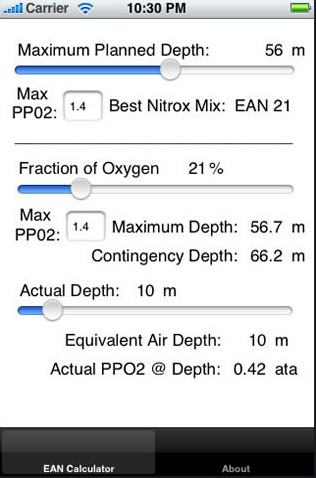
5) iDive Nitrox, $0.99 There are a few nitrox calculation apps for the iPhone. So far every diver with an iPhone uses a different one based on their personal preference. They all basically do the same job. I like iDive Nitrox as it’s a little less clunky than some of the others and gets straight to the point. It offers a simple calculator for maximum operating depth, contingency depth, equivalent air depth and partial pressure of O2. All done by using the handy sliders. Quick easy and reliable. Sold!
Other notable iPhone apps:
Dive Buddy Russell Clark is a cold water diver and founder of Earth Periodical, conservation and exploration iPad magazine, available for free from the iTunes store here.
Scuba Wetsuit Care 101: Removing Odors & Extending Suit Life
If you want your wetsuit to last as long as possible, a bit of proper wetsuit care is all you need. The difference between a wetsuit with a 1 year life and 6 year life depends, to a certain extent, on how often you are using it. But to a larger extent, how well you take care of your wetsuit is going to either quicken or slow its deterioration. Below are 13 care tips for extending wetsuit life.
1. Neoprene and Hot Water Are Not Friends
Neoprene loses some of the flexibility when soaked in hot water. So hop in a cold shower with your wetsuit on or only soak it in lukewarm water.
2. Sun & UV Rays Deteriorate Neoprene
Sun and UV rays both cause your neoprene wetsuit to age more quickly. So if you need your scuba suit to dry, don’t try to hasten the process by placing it in the sun. In the long run, the neoprene will become hard and lose flexibility.
3. Don’t Put Your Wetsuit in a Hot Trunk
If your car has been sitting in a parking lot on a hot day, then putting your wet suit into the trunk is not a great idea. This will essentially “cook” your gear, increasing smells and breeding bacteria.
4. Turn Your Wetsuit Inside Out to Dry
To dry your wetsuit, its best to first turn it inside out before hanging it up. By turning the suit inside out, flexibility will be maintained on the outer side. This means that even if the wetsuit it not 100% dry to next time you put it on, you’ll for sure be crawling into a drier side.
5. Carefully Store
Carefully store your dry wet suit on a flat surface or hang on a wide coat hanger in your closet.
6. Quickly Clean & Dry Your Suit
After a dive, don’t let your wet wetsuit sit in your dive bag, all stinky, messy and sandy. Clean the suit quickly and dry it completely before storing away. This type of regular wetsuit care will be sure to increase its lifespan.
7. Avoid “Messy Dressing”
If you’re doing a beach or shore dive, keep your wetsuit up and aware from the mud/ sand. Its not so comfortable to pull on a sandy wetsuit! Also, when you take off your wetsuit, stand on pavement, a rock, your changing bag, grass or anything besides the middle of the sandy beach.
8. Wetsuits Don’t Belong in the Washer
Neoprene wetsuits must be handled with care and can’t be put through the washer and dryer. You have to hand wash and air dry.
9. Can I Iron my Wetsuit? …. No!
It’s a no-brainer that you should not iron your wetsuit. Just look at the rubber areas around the zippers and knees. Also, if you were to iron the neoprene, that amount of excessive heat would make the suit very stiff.
10. Bleach is Off-Limits
Strong washing agents, such as bleach, are way too harsh for your neoprene wetsuit (not to mention the discoloration that will occur). There are some mild cleansing agents, such as “Sink the Stink” and “Trident Wetsuit Cleaner” that you can purchase from your local dive shop, but regular dish detergent will work just as well (read on to find out how to get rid of wetsuit smells on your own).
11. Why Does My Wetsuit Stink?
Your wetsuit can stink if it was left, wet, in a bag for a while and wasn’t rinsed. The smell comes from bacteria that begin to feed on the normal sweat and body oils and odors clinging to the wetsuit after we use it. Also, if you urinate in your wetsuit, the pee can leave an odor behind.
12. How to Get Ride of Wetsuit Smells & Odors
As I mentioned, there are special cleaning soaps and solutions for getting rid of wetsuit odors, but I personally, find that there is an easy, more economical way to erase suit smells. Here is my homemade recipe for washing smelly wetsuits:
- 1st: Fill the tub up ¼ of the way with fresh, warm (not hot) water.
- 2nd: Add a couple tablespoons of dish washing detergent, just enough to get a dilute bubbly water bath for soaking.
Note: Some people will use laundry detergent, but I think even that is too harsh for neoprene (and tougher to rinse off). The only laundry detergent to consider using is Woolite. - 3rd: Wash your wetsuit in the tub of soap and the detergent will break down the body oils and odors. In addition, it will help wash away the bacteria that caused the smell in the first place .
- 4th: Rinse your wetsuit in fresh water in order to get all the detergent off. Then hang your wetsuit up to dry in the fresh air (away from direct sunlight).
- 5th: Every few weeks, repeat this process to keep your wetsuit completely odor-free!
Tank Cave - Cave Diving Australia
Cave Name: Tank Cave
Reference: 5L-230
Cave Area: Lower South East
Description: Named because a water tank used to rest right over the top of the entrance, Tank Cave is an extensive, maze like system with over 8km of diveable passage which makes it one of the longest underwater caves in Australia.
Owner/Manager: Rob Dycer
Access: Via CDAA. Cave leased to CDAA..
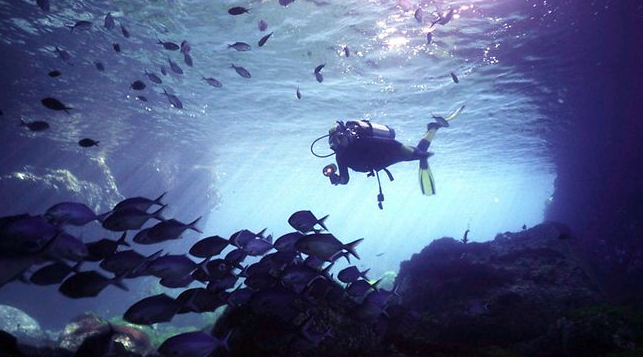
The South Australian region near Mt Gambier is known of it’s many sinkholes and caves. One particular cave that stands out amongst the rest is Tank Cave. Tank Cave is probably the most complex and biggest cave system in Australia, with more than eight kilometers of underwater passages. The cave is relatively shallow a max depth around 65ft (20m). This system gets its name from the fact that there used to be a water tank directly over the top of the entrance.
Rumored since the late 1960s as a “cave diving site” of some type, this amazingly extensive feature is today considered by many to be the the best cave diving as far as South Australian cave diving sites
The Tank Cave entrance is on private property and the Cave Divers Association of Australia (CDAA) strictly control access to the dive site. The complicated nature of the cave system, requires a strict familiarization process that allows cave divers to get to know the cave step by step. You must go through this process before you are allowed access to the site, the clear benefit means that every cave diver is very familiar with all the main passages of Tank Cave before they can explore further.
Suunto Movescount & Scuba Diving
New to the diving community is the revolutionary Suunto Movescount, a user friendly tool to share all of your sporting activities with the world. Mainly this community has been used for runners and bikers to share and record their times, as well as gain likes and achievements through the website.
Suunto has decided that they should give divers an equal opportunity to share their exciting dive adventures. Movescount is a great visual tool for you to gain instant satisfaction from posting your dives to the world and sharing them with other divers. With Movescount you can also log your own personal achievements without sharing with others if you’re feeling a little anti-social, or just want to surprise the world at a later date!
Scuba diving has been looking for a tool like this, and with Suunto being one of the leading suppliers of dive equipment it only seems fitting that they would have the tools to make this happen. The website has a nice interface, almost “Facebook like”, giving you the ability to add fans, follow athletes, join groups and customize your own profile. A digital logbook if you will, with the ability to access from anywhere at anytime. This is a also a great tool for finding new dive buddies and connecting with people that you have met through the site. So bringing your laptop on vacation can now be mixed with your dive computer to record even more information about your awesome dives, and to record your bottom time accurately. This is not ONLY a tool to record your scuba diving activity, it has almost every sport you can think of, and from martial arts to badminton you can record ALL of your sporting activities.
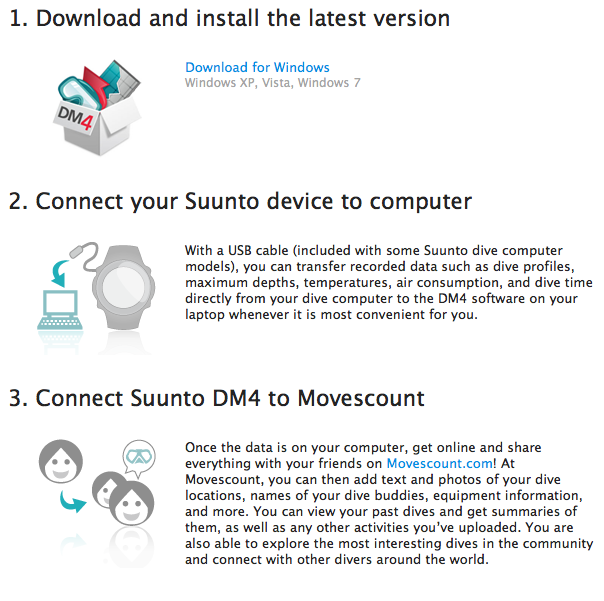

Every good technology company knows, if you make a web interface for your industry, you should most definitely make a tool to use it on the fly! Like the new Suunto D6i, which allows you to easily upload and store all of your dive information directly from your laptop to Movescount.com. The watch itself is not different in any way from the D6, adding an “i” has only given it the ability to transfer directly to the website without any data having to be input by the user. The Suunto D6 is a great wrist computer that could easily pull off being an expensive wrist watch. When I travel and teach scuba diving my D4 never leaves my wrist, maybe it is time for me to upgrade to the D6i and start tracking my moves! This technology is new, and will begin to be a very exciting craze of sharing your healthy movements to your friends and newly acquired fans.
You can take a tour of Suunto Movescount by Clicking Here
Check out www.scubadiverlife.com to learn all about diving if you aren’t a scuba diver already, if you are; check us out and then head over to www.movescount.com and sign up for your account!
Saturday, July 2, 2011
Sea Shepard Cause
Please join the following Cause. These guys are called pirates but without them, the sea's/oceans are a free for all slaughter house, the marine life can't fight or talk for themselves, so please help out.


A One Dollar from everyone who visits, will make a load of difference. Tell your friends as well. I'm sure you can spend a dollar, or have a look at there shop and purchase something cool, which also is a donation.


About
Sea Shepherd is a direct-action conservation group lead by Captain Paul Watson, a man whom author Farley Mowat calls "the world's most aggressive, most determined, most active and most effective defender of wildlife."
Join the official facebook page!
http://www.facebook.com/seashepherdco...
Goto the website. http://www.seashepherd.org/
Tell your friends.
Join the official facebook page!
http://www.facebook.com/seashepherdco...
Goto the website. http://www.seashepherd.org/
Tell your friends.
Affiliated With
SEA SHEPHERD CONSERVATION SOCIETY
Donations Go To…
SEA SHEPHERD CONSERVATION SOCIETY
A 501(c)(3) nonprofit
A 501(c)(3) nonprofit
Positions
- Defend
- Conserve
- Protect
Wednesday, June 15, 2011
Deep Diving
As new divers, the seemingly arbitrary 20m depth restriction seems kind of foolish; after all, you’ve got your tables right? You just picked up that sweet computer from the shop that’s rated to 100m, so why can’t you go there? Well, to be frank, while deep diving is really an extension of fundamental skills you’ve learned as an Open Water Diver (or equivalent), there are a few things that set it apart and so additional training and familiarization is recommended before you charge down to 40m! The keys for safe deep diving are redundancy, equipment and situational awareness. Deep dives are different from regular, shallower dives because the environment can change quite a bit on the way down. Where the first 10m of a dive might be decent for vis and light, it might be near night diving conditions deeper. Absorption and turbidity eat away at the colours you can see, and your air supply dwindles faster. In addition to all that, narcosis effects can become more pronounced as well, adding an element of risk all its own to the dive.
Ensure to check your Depth
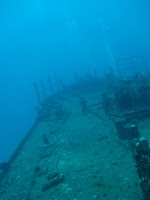
Wreck Diving does get deep
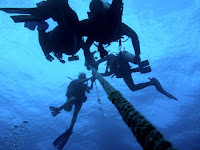
Safety Stops are a must
If you’re planning a deep dive, plan for all reasonable contingencies. Use redundant equipment for vital things like your depth gauge (probably the most important redundancy). Carry at least one dive light, but a secondary is never a bad plan. Talk to local divers and find out the conditions that you might be facing when you get to the bottom. If it’s a wall dive, watch your depth gauge(s) like a hawk! Some computers can be set for deep stops, so this is a good option as well. Situational awareness is a trait that good divers seek to develop as much as possible over their diving careers. In a deep dive, it’s as important as it would be on a night or wreck dive. Paying attention to your depth, watching your dive buddy and yourself for narcosis and keeping track of your air are the most key things to watch. And finally, brush up on your certifying agencies emergency decompression stop rules and write them on your slate so you don’t forget. You’re already increasing your risk of DCI, so there’s no sense increasing it further by blowing your tables and not taking the needed stop. Safety stops aren’t optional with deep dives!
Ensure to check your Depth

Wreck Diving does get deep

Safety Stops are a must
If you’re planning a deep dive, plan for all reasonable contingencies. Use redundant equipment for vital things like your depth gauge (probably the most important redundancy). Carry at least one dive light, but a secondary is never a bad plan. Talk to local divers and find out the conditions that you might be facing when you get to the bottom. If it’s a wall dive, watch your depth gauge(s) like a hawk! Some computers can be set for deep stops, so this is a good option as well. Situational awareness is a trait that good divers seek to develop as much as possible over their diving careers. In a deep dive, it’s as important as it would be on a night or wreck dive. Paying attention to your depth, watching your dive buddy and yourself for narcosis and keeping track of your air are the most key things to watch. And finally, brush up on your certifying agencies emergency decompression stop rules and write them on your slate so you don’t forget. You’re already increasing your risk of DCI, so there’s no sense increasing it further by blowing your tables and not taking the needed stop. Safety stops aren’t optional with deep dives!
Planning and conducting deep dives is a big part of diving for me and many other people, particularly the Tec set. While you are able to go to whatever depth you want, it’s good to get the extra training (and master Dalton’s Law) before you just plunge in. 40m is a long way from the surface and a safe dive is a good dive!
Monday, June 13, 2011

Monday, December 8, 2008
Dive safety basics
You've had a physical, you're certified and your diving equipment has passed inspection. For a safe, enjoyable dive, follow these additional tips, starting with two oft-repeated diver's sayings.
- Never dive beyond the depth of your experience. Don't try a dive you're not comfortable with, and stay out of wrecks and caves unless you've had professional instruction and are properly equipped.
- Plan your dive, and dive your plan. Know how far you'll descend and how long you'll be underwater. Use your dive computer—and your common sense.
- Always dive with a buddy. Before you enter the water, review hand signals and your diving plan. Review buddys gear, hand signals, and diving plan before entering the water.
- Never hold your breath. If your regulator comes out of your mouth, emit a tiny stream of bubbles until you get it back in.
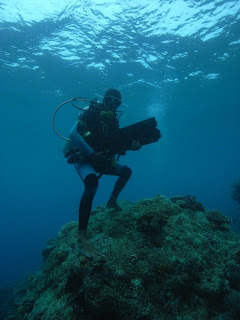
- Equalize your ears on the way down.
- Ascend slowly.
- Be comfortable and confident in your basic skills before taking on the additional requirements of underwater photography.
- Stay alert to your environment, including marine life, weather conditions and boat traffic.
- Don't fly for 24 hours after a no-decompression dive.


Know your diving destination
Before you get in the water, get the scoop on your diving destination. Find out all you can about water clarity, temperature and depths, as well as boating traffic and diving regulations. These factors affect what diving equipment you'll bring and help you plan your dive.
Is the water murky, or clear enough for a camera? Are there sunken boats or other must-see underwater structures? How far off shore, and how deep? How do the tides behave?
Search online for area dive shops and club contact information. Local divers can tell you what to expect and give you tips, like the GPS coordinates of an interesting wreck. Call for up-to-the-minute condition reports, even if you've recently visited the area. Conditions can change quickly, and having the latest details helps you plan a successful diving trip.
How long does one tank of air last?
The rate at which you use air while diving depends on factors such as the depth of your dive, the temperature of the water and your exertion level. Diving 15 to 30 feet in warm, quiet water, you can spend about an hour underwater with an average tank.
Divers use pressure gauges to measure the amount of air remaining in a tank. A handy instrument like the UWATEC; 2 Gauge Console combines a pressure gauge with a depth gauge. Add the optional C-1 Compass, and you can quickly determine how deep you are and in which direction you're swimming-information that lets you range farther from the boat with confidence and safety.
Computers can help your diving
A dive computer delivers key measurements for safer, more accurate diving. Today's sophisticated computers track how long you've been under water and the depth of your dive; calculate the amount of nitrogen in your body; and guide you in making decompression stops as you ascend. Even more advanced dive computers take into account factors such as water temperature, diver exertion to determine remaining bottom time before you need to begin a safe ascent to the surface factoring in any decompression stops needed with a safe backup supply of air.
Such precise nitrogen management makes it possible for divers to go deeper and stay underwater longer without compromising safety. Instead of calculating your dive profile with tables based only on the elapsed time and the deepest point of your dive, you have a profile that considers all the real-life variables. Using a dive computer, you may be able to double the length of your dive.
The Aladin TEC 2G wrist computer, made by UWATEC®, is accessible, easy to use and packed with features. It combines dive functions with an altimeter, average depth indicator and gauge mode with stopwatch functions. SmartTRAK software lets you download and manage dive profiles using your home computer.
What's a diving regulator?
A diving regulator supplies you with air or a special mix of breathing gases from a cylinder you carry on your back. Diving equipment manufacturers make a range of regulators for different environments and diver preferences.
There are typically four components to a regulator system: first stage, second stage, alternate, and gauges. The first stage attaches to the tank, converting high-pressure air to intermediate pressure. The second stage converts the intermediate-pressure air to breathable pressure. The alternate is a backup regulator, and the gauges measure air pressure and depth.
Transporting your dive gear
Diving gear transportation can be as simple as a luggage trolley with a plastic box and bungee cords, or as elaborate as a water resistant case that opens from two directions.
The basics include a mesh bag for rinsing and carrying fins, and a pouch to protect your gauges. Try the faithful stubbie holder on this. Just cut one end out and slid over your gauges. Wheeler Bag doubles as a gear bag with a sturdy telescopic handle and can be transformed into a backpack bag for more intense exploration.
Look for a case with plenty of pockets to organize your gear; a hard-sided, padded compartment to protect breakable equipment; and telescoping handles and easy-glide wheels for comfortable travel. Consider packing a mesh rucksack to use as a transition bag. When your gear arrives at your dive destination, leave the traveling bag in your room and head out with the lighter rucksack.
Subscribe to:
Posts (Atom)