Showing posts with label Scuba Training. Show all posts

Monday, June 11, 2012

Sexy Diver - Jessica Alba

Do you want to be a sexy diver? Need to get fit? Now we have the reason why Jessica Alba looks like this. So how can you become the next Jessica Alba thanks to Scuba Diving…

Think of the amount of calories you loose while scuba diving.

Here we go:

Shapely legs: Swimming with fins (flippers) is like water-based weight-training – firming the front of the thighs as you kick down and the back of the thighs as you kick up. 4 stars

Weight loss: Surprisingly good for burning energy. Someone weighing approximately 70kg (11st) burns 13 calories a minute while scuba diving, so a 45-minute dive would use 585 calories. 3 stars

Cardiorespiratory fitness: According to the British Thoracic Society, scuba divers tend to have larger-than-average lungs and an increased vital capacity (the maximum volume of air exhaled after inhalation). 4 stars

Upper-body strength: The back, shoulders and arms get a certain amount of work lugging around equipment, but once in the water, the upper body gets off lightly. Arms are usually folded across the chest or kept by the sides. 2 stars

Convenience: Even if you decide to dive in the Australia, it’s still an equipment-heavy, location-specific, expensive sport that requires a licence, and therefore tuition. 1 star

Tuesday, July 19, 2011

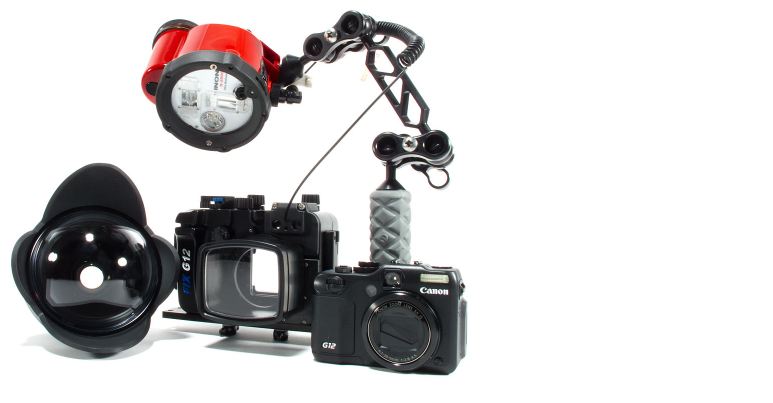
Get Rid of the Blue in your Scuba Photos

Are you sick and tired of your photos coming out Blue? You may be new to underwater photography so you should no one simple trick. What is it? White Balance!
You need to make sure you white balance underwater at depth. Think of you camera as if the lens is the eye and the complex system in it is a brain. When humans dive underwater the color spectrum is altered and this is the case for your camera.

Adjusting your whit balance underwater tells your camera that what is white underwater. You need to make sure you have a white card with you during your dive. Adjust your white balance for the depth you are photographing at, make sure that if your depth changes by more than 10ft/3m you need white balance again. Note if you are using a strobe then shoot the white balance card at full power. Your strobe or flash emits light at a certain color temp, usually 5500K, similar to sunlight, but it depends on the strobe. Most strobes are between 4800K and 5600K. The color temp of the light will change as it passes through water, and reds are filtered out. Remember to switch your white-balance back to auto when using the flash, otherwise your photo will look very red.

If you are lighting up a close subject with your strobe or internal flash, your color temp should be set to Auto. If you are not happy with the color you are getting, which may happen in low-end compact cameras, you can try setting it to sunny or flash, which are both around 5500K. Setting the white balance to cloudy (6000-6500K) when using strobes will usually result in photos that are a little too orange, unless the subject is a few feet away.

White Balance Mistakes:

  • Any white balance mistakes can be easily corrected if you are shooting in RAW
  • Setting a manual white balance, and then forgetting to switch to auto white-balance and using your flash or strobes will result in a nice red photo, oops!
  • Taking an ambient light shot underwater , and leaving the white balance on auto, sunny, or flash will result in a mostly blue photo void of color, especially if you are deeper than 10-15ft deep.
  • Make sure you increase the contrast of your ambient-light photo afterwards in photoshop.

Padi Mobile Application


Padi has just stepped up their game by coming out with a new Padi Mobile Application for both Android and iPhone devices. It’s a good start for Padi, allowing users to find a Padi Dive anywhere in the world.

You are able to use your phone to search by city, state or zip/postal code for PADI Dive Centers or Resorts all over the world —or select your current location and find the closest PADI Dive Center or Resort.

The PADI App gives you the option to view your search results in a list format starting with the closest Dive Centers and Resorts, or map format. Click on the listing and you’ll get the center’s contact information and PADI Five-Star status (PADI store rating). With some listings you’ll even get things like the PADI courses offered at that facility, brands of gear they carry and more.

I’m sure that this is just a start for the Padi mobile application. As there is much more function that should be enabled. Like dive logs, buddy finders… let’s see.. maybe Scuba Diver Life will beat them to the finish line.

Discover Scuba Diving

If you’re conducting a Discover Scuba Diving program, that’s the more common certification of its kind, they’ll begin with a bit of paperwork, then show you to the instructor. Additional diving certification organizations such as SSI possess similar programs which follow similar, yet differing procedures, all possess the exact same goal; to have a good time and make you be confident and safe within the water.

Plus, you can get credit! If your Discover Scuba Diving program includes an actual scuba dive in open water, your experience may count toward PADI Scuba Diver or Open Water Diver certification, putting you a step ahead of the game when you decide to go for it.

Your instructor will probably have you view a flip chart. The Discover Scuba Diving flip chart will posses vital dive theories and crucial diving rules and ideas which are critical to remember, like the golden rules of diving, 1) Never hold your breath, 2) Equalize your air spaces and ears each couple of meters or as pain is felt.

Next, your instructor will conduct a pre-diving brief explaining the skills, signals and procedures which you’re going to perform within the water, that involve skills for replacing and recovering the regulator, clearing your mask of water, as well as using and finding the different air source. There’re a few additional easy skills which you’ll be expected to perform. Your instructor will assist you with your equipment, then be sure that diving gear will be set up properly.

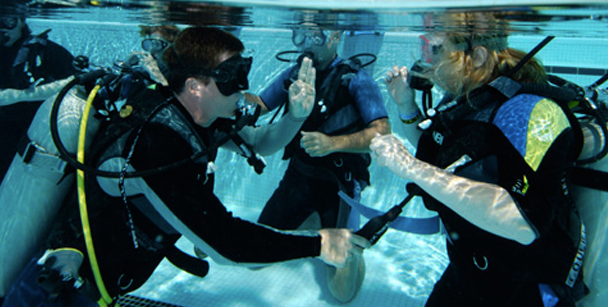
Then, your instructor will take the group within a pool, or shallow water, that you could stand in. Your instructor should discuss the skill which you’re going to perform, then you’ll go under the water together. Your instructor should first perform the skill, then ask every individual to conduct the skill.

Lastly, your instructor, in most instances, will take your group from the area of teaching, out to the region where they could take you on the underwater tour, showing you an entirely new world. For many, it’ll be a dream come true, and surely one that you’ll recall for a lifetime.

Some other learnings:

  • Learn what wearing scuba equipment feels like and how easy it is to move around underwater while wearing it
  • Find out what it’s like to breathe underwater and learn whether you can be comfortable there
  • Learn some basic skills and safety rules that will carry over to your full scuba certification course when you take the next step

Nitrogen Narcosis

Scuba diving will be an amazing leisurely sport which you’ll enjoy once you attempt it. It’s due to you getting the opportunity to interact with numerous vibrant sea creatures discovered residing amongst the gorgeously formed majestic stones and corals. There’re only a few ideas which you must understand about it so you’ll enjoy fully the exploration as you’re minimizing the risks included with the sport. The compressed air which the tank possesses has a combination of 78% nitrogen and 21% oxygen.

Nitrogen narcosis could lead to an effect almost like liquor intoxication and usually happens at more than 100ft. During this moment, a victim will suffer a lowering within his ability to comprehend things which are occurring around him and judgment ability will additionally be crucially impaired. At this point, he might perform things that must not be performed at all, such as removing his goggles or other vital portions of his diving gear such as his fins or regulator s.

If you view your diving companion showing symptoms of this condition, you need to instantly help him make a controlled rise upward toward the surface, while observing all abnormal behaviors which the companion may show. The symptoms involve decreased dexterity, anxiety that’s manifested within their body behaviors, increased excitability, over confidence in dealing with a crucial situation, and delayed response to auditory or visual prompts.

As you view these symptoms manifesting within your diving companion, or if you begin to sense the exact same symptoms yourself, instantly start an ascent toward shallow waters. As you get nearer to the surface, you’ll see the symtoms and effects slowly dissipate. Following this, don’t attempt to dive in again for the rest of the day.

Nitrogen narcosis could be prevented by remaining within shallow waters. Though 18m might not be your idea of an amusing diving exploration, it’s a safe depth that will prevent this condition from arising.

Wednesday, June 15, 2011

Deep Diving

As new divers, the seemingly arbitrary 20m depth restriction seems kind of foolish; after all, you’ve got your tables right? You just picked up that sweet computer from the shop that’s rated to 100m, so why can’t you go there? Well, to be frank, while deep diving is really an extension of fundamental skills you’ve learned as an Open Water Diver (or equivalent), there are a few things that set it apart and so additional training and familiarization is recommended before you charge down to 40m! The keys for safe deep diving are redundancy, equipment and situational awareness. Deep dives are different from regular, shallower dives because the environment can change quite a bit on the way down. Where the first 10m of a dive might be decent for vis and light, it might be near night diving conditions deeper. Absorption and turbidity eat away at the colours you can see, and your air supply dwindles faster. In addition to all that, narcosis effects can become more pronounced as well, adding an element of risk all its own to the dive.


Ensure to check your Depth

Wreck Diving does get deep


Safety Stops are a must

If you’re planning a deep dive, plan for all reasonable contingencies. Use redundant equipment for vital things like your depth gauge (probably the most important redundancy). Carry at least one dive light, but a secondary is never a bad plan. Talk to local divers and find out the conditions that you might be facing when you get to the bottom. If it’s a wall dive, watch your depth gauge(s) like a hawk! Some computers can be set for deep stops, so this is a good option as well. Situational awareness is a trait that good divers seek to develop as much as possible over their diving careers. In a deep dive, it’s as important as it would be on a night or wreck dive. Paying attention to your depth, watching your dive buddy and yourself for narcosis and keeping track of your air are the most key things to watch. And finally, brush up on your certifying agencies emergency decompression stop rules and write them on your slate so you don’t forget. You’re already increasing your risk of DCI, so there’s no sense increasing it further by blowing your tables and not taking the needed stop. Safety stops aren’t optional with deep dives!

Planning and conducting deep dives is a big part of diving for me and many other people, particularly the Tec set. While you are able to go to whatever depth you want, it’s good to get the extra training (and master Dalton’s Law) before you just plunge in. 40m is a long way from the surface and a safe dive is a good dive!