Showing posts with label reefs. Show all posts

Wednesday, June 27, 2012

Immersed Senses

Improving the limitations of current scuba diving system, designer Adam Wendel has come up with a futuristic device named the “Immersed Senses” that changes the way the diver sees, hears, and breathes underwater, allowing them to become a part of their surrounding environment. Immersed Senses is the future of underwater diving and exploration. Featuring a LED flashlight to let the diver to observe the dark depths of the ocean, the mask also includes a large OLED glass display to offer a panoramic view of the surroundings. The OLED enclosed helmet also allows the extracted oxygen to flow freely throughout the helmet, as if you are breathing on land without any breathing apparatus.


While an interactive OLED display gives access to underwater GPS maps, therefore allowing the diver to navigate efficiently throughout the ocean’s landscapes. The OLED also offers software that can identify all species of fish, coral and other ocean dwelling creatures that diver is currently viewing. With Immersed Senses, experiencing the underwater world is now fully interactive. In addition, the OLED screen depicts important info such as oxygen toxicity, nitrogen levels and even body heat to keep the diver well informed and safe.

Made in haptic glass, the device concept touts futuristic technology to the core. An optically clear glass with microscopic pours keeps water molecules out, yet it allows sound waves to pass through. Sound travels six times faster underwater than on land, however it is nearly impossible to interpret where the sound is coming from. The haptic glass interprets the sound wave orientation then displays the source and direction on the OLED display.

Water leakage is eliminated with the use of a silicone lining that seals the helmet to the skin. The silicone’s flexibility affords the diver to explore with comfortable movements. The orange side panels assist in internal circulation of the extracted oxygen. The rear of the helmet contains an electrolysis reactor that extracts oxygen from saltwater. The breathable oxygen is circulated throughout the helmet, creating a revolutionary underwater breathing experience.

Immersed Senses operates by a battery that utilizes a centrifuge mechanism to pull oxygen from seawater that begins the electrolysis reaction. Saltwater is extracted into the bottom reservoir that reacts with hydrogen gas. The saltwater is then charged by a positive and negative anode/cathode that generates breathable oxygen. Two internal devices help to circulate the oxygen to the diver’s mouth and nose.

The diver then breathes in the oxygen and out carbon dioxide, which exits the helmet. The battery and stored hydrogen can keep a diver submersed for up to 8 hours. The Immersed Senses revolutionizes how a human can breathe underwater, as well as interact with the OLED display offering a panoramic view of the deep sea.


Friday, June 8, 2012

Packing Tips for Photographers

It used to be so easy to get to distant dive locations with virtually any amount of camera gear needed to do the job. Load up a dive bag, a clothing bag, maybe a big roller case for topside cameras to go on the airplane with you--then stuff the rest in a giant hard case. Some shooters had different strategies, maybe an Igloo cooler with the lid duct-taped down to make it look like a cargo of dead fish rather than live cameras, hoping to avoid theft. But the common feeling was that overweight was an after-thought, and if we got charged at all, it would be maybe $50. But as Mr. Dylan once sang, "the times they are a-changin'," and as fuel costs force airlines' bottom lines deeper into the red, they pass some of those costs along to their passengers in the form of baggage fees. Underwater photographers get hit especially hard, so for shooters feeling the pinch, here are five tips for packing, planning and navigating baggage restrictions on your next dive trip.

To emphasize how significantly times have changed, I just came home from an otherwise terrific trip to the Red Sea. To get there, I went via London on an international carrier, which wasn't overly restrictive. But I connected with a charter flight to Marsa Alam, Egypt--low-cost charter flights with few amenities are a common choice for divers traveling from Europe--and that carrier was extremely restrictive in its baggage allowance, with astronomical overweight charges. What's the lesson here? Know what you're in for ahead of time. Domestic U.S. flights, which may include flights to the Caribbean and Mexico, international flights and charter flights often have different baggage allowances and fees. For each carrier you're ticketed with, check the web site for updated information about baggage allowances and fees for the type of flight you're on so you can pack and budget according to the most restrictive leg of your trip.

The overweight charge on my charter flight to Marsa Alam was about $6.81 per pound. Each passenger was allowed 55 pounds for the combination of dive gear, clothing and camera equipment. Normally I travel with two 60-pound cases, one hard case for housings and strobes and one dive bag for gear and clothing. That's 120 pounds, and then I have a wheeled carry-on case for my topside cameras that weighs another 40 pounds. If I traveled as normal, I'd have been 105 pounds overweight, paying $715 in overweight fees, each way. Sometimes, you'll get lucky. Going to Marsa Alam, I didn't get charged any fees, but I took that to be luck-of-the-draw in getting a generous gate agent because other travelers with the same amount of baggage or less got thoroughly hammered. On my return flight, I got one particularly strict baggage inspector who hit me with $600 in overweight charges. Pack and weigh your bags well ahead of time, and do the math to figure out the maximum cost in fees you may incur. Then budget this amount into the cost of your trip to avoid spending more than you planned. A handy little travel tool is Balanzza--balanzza.com--a lightweight digital scale that will tell you exactly what your bags weigh, in pounds or kilos.

Not every shoot requires the same gear, and it's rare that one destination requires every piece of equipment I have. For the Red Sea I shot predominantly wide-angle because the area's signature scenes are massive schools of fish and lavish soft coral formations punctuated by brilliantly colored tropical reef fish. All these features were so compelling there was no way I was shooting macro. So I left my flat port and macro lenses at home. If overweight charges will be a problem, plan your shoot according to the best photo opportunities at the destination, and leave the rest behind.

Underwater photographers need to accept that airlines are going to make money any way they can, and hitting us for overweight is likely to be the their easiest, quickest revenue-generator. To avoid being lambs-to-the-slaughter, we need to get clever in terms of how we pack. The most fragile and irreplaceable items should come aboard as carry-on. At the very least, carry-on a single digital camera body and a few primary lenses, as well as a laptop computer and portable hard-drive. Ideally, you would carry-on your housing as well--you might be able to rent a strobe on location if your checked baggage is lost or delayed, but you'll need the camera-specific housing. Having said that, I usually check my housing, just because it is big and heavy, but if you use a smaller, lighter housing, get it in your carry-on if possible.

When planning your packing strategy for a photo trip, don't forget your contingency plan. A good tool kit for field repairs can help minimize redundant equipment. If you can fix certain parts of your setup, you may be able to avoid the weight and expense of a spare. Here are some basic suggestions for your Save-a-Camera kit:

  • Spare camera body - If the worst happens and your housing floods, you can dry out the housing and go back to work. But the delicate camera electronics will most likely get fried. A second camera body of the same configuration allows for quick replacement of drowned gear, and makes those topside shots easier if your only camera isn't already encased in a housing.
  • Tools should include a small crescent wrench, vise grips and/or pliers, jeweler's screwdrivers, a pocket knife, small flashlight, air bulb, lens cleaning cloth and a device for cleaning dirty sensors. I use a brush from visibledust.com
  • Extra cords for the strobes, and if possible, a third strobe head so you've got a back-up for dual strobe work.
  • Spare O-rings for your housing and strobes, and extra O-ring grease, are must haves. And always make sure you use the type of grease recommended by the O-ring manufacturer. Mixing and matching different brands can cause O-rings to swell and fail.

Underwater Photography at it's best

‘Untitled’ – Sweetlips in an unspecified location
Photograph: Jose Alejandro Alvarez/Barcroft media

‘Are you looking at me?’ – Jack fish in Sipadan, Borneo, Malaysia
Photograph: John Hill/Barcroft Media

‘Continental trench’ – A diver in a continental trench in Silfra, Iceland
Photograph: Magnus Lundgren/Barcroft Media

‘Harlequin shrimps’ – Harlequin shrimps in Tulamben, Bali, Indonesia
Photograph: Francesco De Marchi/Barcroft Media

‘Lion Fish’ – A lion fish with schooling glassfish in the Red Sea, Egypt
Photograph: Amir Stern/Barcroft Media

‘Multitude’ – schooling catfish in Indonesia
Photograph: Acevedo Eduardo/Barcroft Media

‘Hitting sailfish’ – Sailfish attacking schooling fish in Port St Johns, South Africa
Photograph: Alexander Safonov /Barcroft Media

‘Schooling Jacks’ – Diver and schooling jackfish in Indonesia
Photograph: Maria Rivarola/Barcroft Media

‘Stargazer’ – Stargazer in Blue Heron Bridge, Florida
Photograph: Keri Wilk/Barcroft Media

‘Struggle for freedom’ – Baltic herring inside a net in Baltic Sea
Photograph: Karel Bernard/Barcroft Media


Thanks to Keri’ – Juvenile flying fish in Raja Ampat, Indonesia
Photograph: Michele Davino/Barcroft Media

‘Underwater Sadness’ – A sea turtle caught in a net in Sea of Cortez, Mexico
Photograph: Ramon Dominguez/Barcroft Media

Tuesday, July 19, 2011

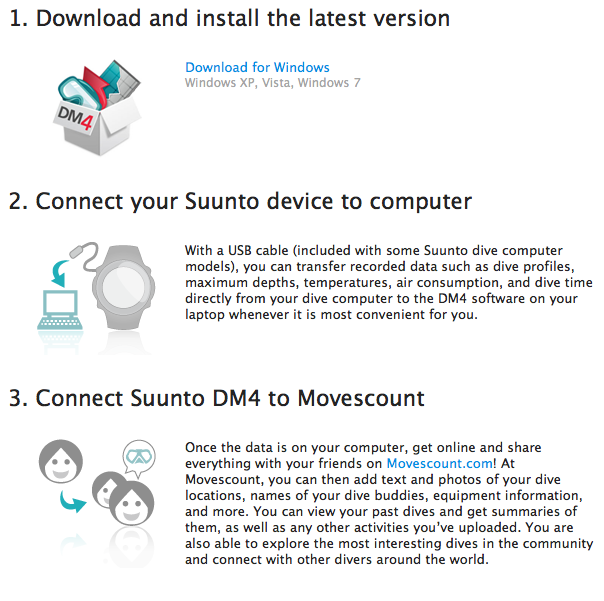
Suunto Movescount & Scuba Diving

New to the diving community is the revolutionary Suunto Movescount, a user friendly tool to share all of your sporting activities with the world. Mainly this community has been used for runners and bikers to share and record their times, as well as gain likes and achievements through the website.

Suunto has decided that they should give divers an equal opportunity to share their exciting dive adventures. Movescount is a great visual tool for you to gain instant satisfaction from posting your dives to the world and sharing them with other divers. With Movescount you can also log your own personal achievements without sharing with others if you’re feeling a little anti-social, or just want to surprise the world at a later date!


Scuba diving has been looking for a tool like this, and with Suunto being one of the leading suppliers of dive equipment it only seems fitting that they would have the tools to make this happen. The website has a nice interface, almost “Facebook like”, giving you the ability to add fans, follow athletes, join groups and customize your own profile. A digital logbook if you will, with the ability to access from anywhere at anytime. This is a also a great tool for finding new dive buddies and connecting with people that you have met through the site. So bringing your laptop on vacation can now be mixed with your dive computer to record even more information about your awesome dives, and to record your bottom time accurately. This is not ONLY a tool to record your scuba diving activity, it has almost every sport you can think of, and from martial arts to badminton you can record ALL of your sporting activities.

Every good technology company knows, if you make a web interface for your industry, you should most definitely make a tool to use it on the fly! Like the new Suunto D6i, which allows you to easily upload and store all of your dive information directly from your laptop to Movescount.com. The watch itself is not different in any way from the D6, adding an “i” has only given it the ability to transfer directly to the website without any data having to be input by the user. The Suunto D6 is a great wrist computer that could easily pull off being an expensive wrist watch. When I travel and teach scuba diving my D4 never leaves my wrist, maybe it is time for me to upgrade to the D6i and start tracking my moves! This technology is new, and will begin to be a very exciting craze of sharing your healthy movements to your friends and newly acquired fans.

You can take a tour of Suunto Movescount by Clicking Here

Check out www.scubadiverlife.com to learn all about diving if you aren’t a scuba diver already, if you are; check us out and then head over to www.movescount.com and sign up for your account!

Saturday, July 2, 2011

Sea Shepard Cause

Please join the following Cause. These guys are called pirates but without them, the sea's/oceans are a free for all slaughter house, the marine life can't fight or talk for themselves, so please help out.


About

Sea Shepherd is a direct-action conservation group lead by Captain Paul Watson, a man whom author Farley Mowat calls "the world's most aggressive, most determined, most active and most effective defender of wildlife."

Join the official facebook page!
http://www.facebook.com/seashepherdco...

Goto the website. http://www.seashepherd.org/

Tell your friends.

Affiliated With

SEA SHEPHERD CONSERVATION SOCIETY

Donations Go To…

SEA SHEPHERD CONSERVATION SOCIETY
A 501(c)(3) nonprofit

Positions

  1. Defend
  2. Conserve
  3. Protect
A One Dollar from everyone who visits, will make a load of difference. Tell your friends as well. I'm sure you can spend a dollar, or have a look at there shop and purchase something cool, which also is a donation.