
Showing posts with label Australia. Show all posts
Showing posts with label Australia. Show all posts
Friday, January 25, 2013

Sunday, July 1, 2012
Real-life mermaid swims with whales
Underwater swimmer Hannah Fraser has been fascinated with mermaids since she was three years old. Hannah, 36, an Australian who now lives in LA, made her first mermaid tail at the age of nine, after seeing the film Splash with Daryl Hannah. Now she works as a model, actress and performer, swimming with whales, dolphins, stingrays and even sharks.

Stunning: Photographer Ted Grambeau captured beautiful photographs of 36-year-old Hannah Fraser swimming with whales in the wild to promote their conservation.

Hannah can hold her breath for up to two minutes and swim to depths of 45 feet, allowing her to move like a real mermaid, without the restraints of diving gear.In these images she is seen swimming with humpback whales off Vava'u Island, Tonga, to promote marine conservation and oppose whale hunting.
Hannah and her then husband Dave Rastovich, a surfer, were upset and frustrated after International Whaling Commission meetings where whaling nations were allowed to continue their slaughter under the guise of 'scientific research'.'It was depressing and we wanted to go somewhere to connect with the whales and to raise awareness,' said Hannah.


The couple flew to Tonga with photographer Ted Grambeau, who was able to capture beautiful images of humpbacks swimming with Hannah, in scenes documented by filmmaker Bali Strickland. 'A baby humpback was curious and actually came up to me,' said Hannah. 'The whales were singing so loudly and the baby whale was squealing, which sounds even louder under the water. It was a very powerful experience.'
Many photographs for anti-whaling campaigns show brutal acts including harpooning and whales being winched onto ships, which can be too horrific for ordinary observers. But Ted's images appear in the children's book, The Surfer and the Mermaid, and aim to inspire whale conservation. He added: 'All the shots of Hannah are really poetic - really just surreal, beautiful shots.'
In 2007, Hannah swam in the sea in Taiji, Japan, with 30 surfers, celebrities and musicians, in an attempt to halt the ruthless slaughter of thousands of dolphins by local fishermen. Hannah remembers: 'Half of the dolphins had been caught and the others were roped off in the middle of the bay to be herded towards the fishermen.


Deep blue: Hannah is seen here swimming with humpback whales off Vava'u Island,
Tonga, to raise awareness of marine life and oppose whale hunting

'Instead of being frightened, the dolphins were trying to come closer to us in their net, as if they knew we wanted to help them. 'But at this point the fishermen were hitting us with sticks and moving their boat propellers towards us. We couldn't get any closer and we couldn't save the dolphins. 'It was indescribable to see this happening and have to abandon them. I cried for hours afterwards. It was hard to be part of the human race at the point.'
Two years later, in 2009, Hannah swam in her tail with 14ft Great White Sharks off Guadalupe island, Mexico. 'I thought if I was going to be a professional mermaid I'd have to face my fear of sharks,' she admitted. After trying out the shark-infested waters in scuba gear, Hannah was about to put on her mermaid tail, when one of the sharks became trapped in the diver's cage. 'Luckily the shark freed itself in time. But it made me realise it was safer not to use the cage,' she said.
'I got my tail on and got into the water. I was supposed to be surrounded by divers, but in the mermaid tail I swim much faster than anyone else. I realised I was on my own, but I stayed calm.'
She added: 'Another time a shark turned round and came towards me, so I made a scary face and screamed at it in the water. Amazingly I scared it off. I felt invincible for months afterwards.' Filmmaker Rob Benavides is currently shooting a documentary about Hannah's life, which will feature her work as a model, diver, and sea-life campaigner. 'One of the imperative messages in marine conservation right now is over-fishing,' she said. 'We should be asking countries to better regulate their fishing industries.
'We shouldn't be eating any fish, but if any it should be only little ones. Large fish take years to grow and reach maturity. If we continue taking them from the ocean it will be a long time before stocks are replenished.' Hannah Fraser is featured in a new children's book Last Night I Swam With A Mermaid by Kimberley Muller.

Inspiration: Hannah says she made her first fish tail after seeing Daryl Hannah play a mermaid in the 1984 film Splash
Monday, June 11, 2012
Sexy Diver - Jessica Alba

Do you want to be a sexy diver? Need to get fit? Now we have the reason why Jessica Alba looks like this. So how can you become the next Jessica Alba thanks to Scuba Diving…
Think of the amount of calories you loose while scuba diving.
Here we go:
Shapely legs: Swimming with fins (flippers) is like water-based weight-training – firming the front of the thighs as you kick down and the back of the thighs as you kick up. 4 stars
Weight loss: Surprisingly good for burning energy. Someone weighing approximately 70kg (11st) burns 13 calories a minute while scuba diving, so a 45-minute dive would use 585 calories. 3 stars
Cardiorespiratory fitness: According to the British Thoracic Society, scuba divers tend to have larger-than-average lungs and an increased vital capacity (the maximum volume of air exhaled after inhalation). 4 stars
Upper-body strength: The back, shoulders and arms get a certain amount of work lugging around equipment, but once in the water, the upper body gets off lightly. Arms are usually folded across the chest or kept by the sides. 2 stars
Convenience: Even if you decide to dive in the Australia, it’s still an equipment-heavy, location-specific, expensive sport that requires a licence, and therefore tuition. 1 star
Friday, June 8, 2012
I can SEA clearly now


Paul Watson, the founder of Sea Shepherd Marine Wildlife Conservation Society has been released. He was bailed from a Frankfurt jail pending a decision on whether he will be extradited to Costa Rica, where he is wanted for supposedly endangering a Costa Rican fishing vessel whilst filming a documentary back in 2002.
On Friday (18th) a Frankfurt court ruled that he could be released on bail for around £200,000. A mystery donor stepped in and he was released on Monday (20th).The Captain was relieved to be out, “I didn't expect something that happened 10 years ago to sneak up on me in Germany.”
Watson must remain in Germany while the extradition case gets haggled over.
Luckily for Paul the Costa Rican President Laura Chinchilla was in Germany on an official visit trying to drum up more foreign investment from Chancellor Angela Merkel. By the time she had arrived in Berlin more than 400 Sea Shepherd supporters had shown up to greet her.
Sea Shepherd called for a global day of action on Wednesday (23rd) asking people to go and stand outside German Embassies and protest. Demonstrations took place outside the German embassies and consulates in Hong Kong, Australia, Canada, US, South Africa, Brazil, Spain, Costa Rica and many other countries.
Keep checking SEA SHEPHERD website for news and updates.
Scuba Pro's Meridian Dive Computer
 SCUBAPRO’s Meridian combines a classy timepiece with an advanced dive computer. The housing is made of marine grade 316-L stainless-steel with a two-toned brushed finish. The display uses bold digits and icons, and is flanked by four control buttons for navigating through the system. A full-featured wristwatch on the surface, when it comes time to hit the water the Meridian lets you choose between Scuba, Apnea or Gauge modes. All modes use an eye-pleasing reverse display backlight and can be equipped with optional heart rate monitors. After the dive, profiles and other data can be downloaded using SCUBAPRO’s LogTrak software, compatible with both the latest versions of Windows and Mac. Bottom Line: As a luxury watch and muscular data cruncher, the Meridian offers state-of-the-art performance, both under water and on the surface.
 For more information:
http://www.scubapro.com
Find this product at your local SCUBAPRO dealer
NSW Acts to Protect Hammerhead Sharks

New South Wales Australia is heading an effort to save two species of hammerhead shark from extinction.
The NSW government has passed legislation to protect the great and scalloped hammerhead sharks in NSW waters, two species whose numbers are being endangered by local fishing and an appetite for shark fin soup.
An ammendment to the Fisheries Management Act 1994 lists the great hammerhead shark as vulnerable and the scalloped hammerhead shark as endangered under the act.
“The listing of these two species is a big leap forward in the conservation of these sharks in NSW waters,” said Alexia Wellbelove of Humane Society International. “These listings will ban the sale and possession of these threatened species and help to provide a safe haven for them in NSW waters.”
Great and scalloped hammerhead sharks are caught in the NSW Ocean Trap and Line Fishery, targeted by recreational fishers as well as being caught in the shark nets off NSW beaches. HSI has consistently called for the removal of bather protection nets off NSW beaches due to the impacts they have on protected species such as the grey nurse shark and hammerhead shark.
“Hammerhead sharks are targeted worldwide for their fins which are of high value. Efforts are underway globally to better conserve our shark species and this is a great first step taken by NSW to protect these sharks,” continued Ms Wellbelove. “We call on the Federal Government and other States to also consider listing these species to ensure they can be afforded the full protection they deserve, and now have in NSW, whilst in all Australian waters.”
Data from NSW, Queensland and international waters suggests that hammerhead sharks have declined by between 75% and more than 90% in less than two generations, representing a very high risk of extinction in the near future.
Notes: The final determinations of the Fisheries Scientific Committee for the great hammerhead shark, Sphyrna mokarran, and scalloped hammerhead shark, Sphyrna lewini, are available at http://www.dpi.nsw.gov.au/fisheries/species-protection/fsc/final
Tuesday, July 19, 2011
Tank Cave - Cave Diving Australia
Cave Name: Tank Cave
Reference: 5L-230
Cave Area: Lower South East
Description: Named because a water tank used to rest right over the top of the entrance, Tank Cave is an extensive, maze like system with over 8km of diveable passage which makes it one of the longest underwater caves in Australia.
Owner/Manager: Rob Dycer
Access: Via CDAA. Cave leased to CDAA..
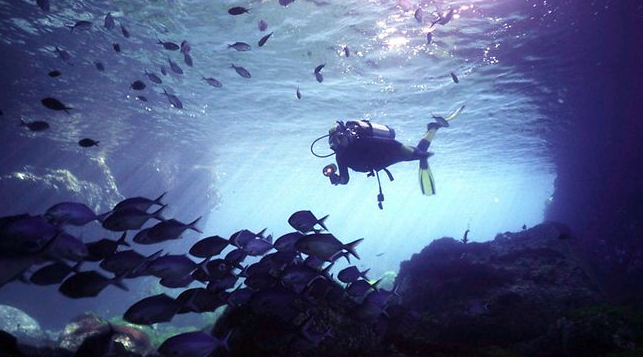
The South Australian region near Mt Gambier is known of it’s many sinkholes and caves. One particular cave that stands out amongst the rest is Tank Cave. Tank Cave is probably the most complex and biggest cave system in Australia, with more than eight kilometers of underwater passages. The cave is relatively shallow a max depth around 65ft (20m). This system gets its name from the fact that there used to be a water tank directly over the top of the entrance.
Rumored since the late 1960s as a “cave diving site” of some type, this amazingly extensive feature is today considered by many to be the the best cave diving as far as South Australian cave diving sites
The Tank Cave entrance is on private property and the Cave Divers Association of Australia (CDAA) strictly control access to the dive site. The complicated nature of the cave system, requires a strict familiarization process that allows cave divers to get to know the cave step by step. You must go through this process before you are allowed access to the site, the clear benefit means that every cave diver is very familiar with all the main passages of Tank Cave before they can explore further.
Saturday, July 2, 2011
Project AWARE
 Project AWARE Foundation works in partnership with divers and water enthusiasts to combat challenges facing underwater environments. We involve these volunteers in hands-on environmental activities like International Cleanup Day and The International Whale Shark Project. Project AWARE also inspires conservation by incorporating its messages in dive training materials as well as creating awareness and education campaigns like Protect the Sharks, Protect the Living Reef and AWARE Kids. The Foundation Grant Program funds grass-roots environmental projects that address key foundation focus areas, volunteer-supported community activism and critical research with direct contributions made by people like you. Follow cause on Facebook
 Donations Go To…
PROJECT A W A R E FOUNDATION
A 501(c)(3) nonprofit
A 501(c)(3) nonprofit
Positions
- Dive carefully in fragile aquatic ecosystems, such as coral reefs.
- Be aware of your body and equipment placement when diving.
- Keep your diving skills sharp with continuing education.
- Consider your impact on aquatic life through your interactions.
- Understand and respect underwater life.
- Resist the urge to collect souvenirs.
- If you hunt and or gather game, obey all fish and game laws.
- Report environmental disturbances or destruction of your dive sites.
- Be a role model for other divers in diving and non-diving interaction with the environment.
- Get involved in local environmental activities and issues.
Sea Shepard Cause
Please join the following Cause. These guys are called pirates but without them, the sea's/oceans are a free for all slaughter house, the marine life can't fight or talk for themselves, so please help out.


A One Dollar from everyone who visits, will make a load of difference. Tell your friends as well. I'm sure you can spend a dollar, or have a look at there shop and purchase something cool, which also is a donation.


About
Sea Shepherd is a direct-action conservation group lead by Captain Paul Watson, a man whom author Farley Mowat calls "the world's most aggressive, most determined, most active and most effective defender of wildlife."
Join the official facebook page!
http://www.facebook.com/seashepherdco...
Goto the website. http://www.seashepherd.org/
Tell your friends.
Join the official facebook page!
http://www.facebook.com/seashepherdco...
Goto the website. http://www.seashepherd.org/
Tell your friends.
Affiliated With
SEA SHEPHERD CONSERVATION SOCIETY
Donations Go To…
SEA SHEPHERD CONSERVATION SOCIETY
A 501(c)(3) nonprofit
A 501(c)(3) nonprofit
Positions
- Defend
- Conserve
- Protect
Monday, December 8, 2008
Dive safety basics
You've had a physical, you're certified and your diving equipment has passed inspection. For a safe, enjoyable dive, follow these additional tips, starting with two oft-repeated diver's sayings.
- Never dive beyond the depth of your experience. Don't try a dive you're not comfortable with, and stay out of wrecks and caves unless you've had professional instruction and are properly equipped.
- Plan your dive, and dive your plan. Know how far you'll descend and how long you'll be underwater. Use your dive computer—and your common sense.
- Always dive with a buddy. Before you enter the water, review hand signals and your diving plan. Review buddys gear, hand signals, and diving plan before entering the water.
- Never hold your breath. If your regulator comes out of your mouth, emit a tiny stream of bubbles until you get it back in.
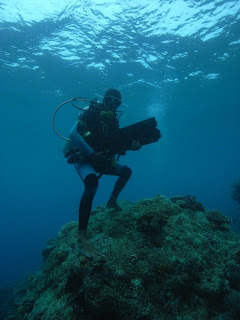
- Equalize your ears on the way down.
- Ascend slowly.
- Be comfortable and confident in your basic skills before taking on the additional requirements of underwater photography.
- Stay alert to your environment, including marine life, weather conditions and boat traffic.
- Don't fly for 24 hours after a no-decompression dive.

Know your diving destination
Before you get in the water, get the scoop on your diving destination. Find out all you can about water clarity, temperature and depths, as well as boating traffic and diving regulations. These factors affect what diving equipment you'll bring and help you plan your dive.
Is the water murky, or clear enough for a camera? Are there sunken boats or other must-see underwater structures? How far off shore, and how deep? How do the tides behave?
Search online for area dive shops and club contact information. Local divers can tell you what to expect and give you tips, like the GPS coordinates of an interesting wreck. Call for up-to-the-minute condition reports, even if you've recently visited the area. Conditions can change quickly, and having the latest details helps you plan a successful diving trip.
How long does one tank of air last?
The rate at which you use air while diving depends on factors such as the depth of your dive, the temperature of the water and your exertion level. Diving 15 to 30 feet in warm, quiet water, you can spend about an hour underwater with an average tank.
Divers use pressure gauges to measure the amount of air remaining in a tank. A handy instrument like the UWATEC; 2 Gauge Console combines a pressure gauge with a depth gauge. Add the optional C-1 Compass, and you can quickly determine how deep you are and in which direction you're swimming-information that lets you range farther from the boat with confidence and safety.
Computers can help your diving
A dive computer delivers key measurements for safer, more accurate diving. Today's sophisticated computers track how long you've been under water and the depth of your dive; calculate the amount of nitrogen in your body; and guide you in making decompression stops as you ascend. Even more advanced dive computers take into account factors such as water temperature, diver exertion to determine remaining bottom time before you need to begin a safe ascent to the surface factoring in any decompression stops needed with a safe backup supply of air.
Such precise nitrogen management makes it possible for divers to go deeper and stay underwater longer without compromising safety. Instead of calculating your dive profile with tables based only on the elapsed time and the deepest point of your dive, you have a profile that considers all the real-life variables. Using a dive computer, you may be able to double the length of your dive.
The Aladin TEC 2G wrist computer, made by UWATEC®, is accessible, easy to use and packed with features. It combines dive functions with an altimeter, average depth indicator and gauge mode with stopwatch functions. SmartTRAK software lets you download and manage dive profiles using your home computer.
What's a diving regulator?
A diving regulator supplies you with air or a special mix of breathing gases from a cylinder you carry on your back. Diving equipment manufacturers make a range of regulators for different environments and diver preferences.
There are typically four components to a regulator system: first stage, second stage, alternate, and gauges. The first stage attaches to the tank, converting high-pressure air to intermediate pressure. The second stage converts the intermediate-pressure air to breathable pressure. The alternate is a backup regulator, and the gauges measure air pressure and depth.
Transporting your dive gear
Diving gear transportation can be as simple as a luggage trolley with a plastic box and bungee cords, or as elaborate as a water resistant case that opens from two directions.
The basics include a mesh bag for rinsing and carrying fins, and a pouch to protect your gauges. Try the faithful stubbie holder on this. Just cut one end out and slid over your gauges. Wheeler Bag doubles as a gear bag with a sturdy telescopic handle and can be transformed into a backpack bag for more intense exploration.
Look for a case with plenty of pockets to organize your gear; a hard-sided, padded compartment to protect breakable equipment; and telescoping handles and easy-glide wheels for comfortable travel. Consider packing a mesh rucksack to use as a transition bag. When your gear arrives at your dive destination, leave the traveling bag in your room and head out with the lighter rucksack.
Choosing the right dive accessories
Diving equipment manufacturers offer an abundance of accessories for use in and out of the water. Here are just a few to consider.
Dive knives are not weapons, but tools-for cutting line, rope, netting or kelp; for adjusting or repairing equipment; even for signaling, with the butt end. Look for stainless steel models with sheaths. Look for stainless steel or Titanium models for corrosion resistance.
New LED and miniature HID lamps offer brighter, more penetrating beams of light. Remember to use sparingly to protect sea creatures.
Use a diver's log made of waterproof paper to keep records of up to 50 dives. And when you get home, store your gear on a specially designed hanger that keeps everything together in a compact space.
One major piece of equipment you might also want to get before buying all the fangangle paraphernalia is a inflatable Safety Sausage or Safety Marker. These things are a must to have on most boats these days and you local dive shop will have them.
Choosing the right mask
Fit is the most important quality of a good diving or snorkeling mask. You want a mask that doesn't leak as you move through the water, no matter which way you turn your face. Mask manufacturers offer models to fit different face sizes and shapes.
Low-volume masks, typically with a two-piece lens, are smaller and require less effort to clear if water fills them. A single-lens mask is usually larger, with seamless side windows creating a panoramic view. Wear glasses or contacts? You can get prescription lens masks from specialty suppliers.
Look for a durable frame and a strap that's easy to adjust even if you're wearing gloves. Good-quality diving masks feature a sealed silicone skirt that thins toward the edge, enhancing fit and comfort. A double-skirted mask has a second skirt at the upper edge, for a better seal.
High-end masks feature a purge valve for easier cleaning. The one-way purge valve lets you clear the water out of the mask without letting water in.
Clean your mask regularly with dishwashing soap and lukewarm water. You'll preserve the quality of its seal and prolong its life.
Choosing the right fins
Fins for snorkeling and diving come in two basic styles: the adjustable open heel and the full foot. Divers can use open heel fins in any environment, adjusting the fins to fit over bare feet or neoprene diving boots. Full foot fins encase the entire foot and are designed for warm-water diving and snorkeling.
The biggest news in fins in recent years is the revolutionary Twin Jet Max Fin, delivering more forward motion with much less effort than traditional fins. The innovative split hydrofoil shape, inspired by the tail of a humpback whale, makes the Twin Jet Max Fin one of the most efficient fins in use today. It comes in both adjustable and full-foot models.
Whatever style you choose, your fins should fit snugly-no wobbling or sliding. Straps should hold the fin comfortably in place, without cutting into your foot or squeezing the ball of your foot into the fin. The fin becomes a natural extension of your foot and leg, propelling you smoothly through the water.
Choosing a buoyancy compensator
Divers wear a buoyancy compensator (BC) to control ascent and descent rates or to hold steady underwater, at neutral buoyancy. Your BC should offer you flexibility underwater and stability at the surface.
Look for a BC that suits your body type. It should fit closely to minimize drag but give you freedom of movement at the shoulder and waist. There are on the market BC's that are designed especially for a woman's torso, optimizing weight distribution and carrying comfort.
Also match your BC to your diving preferences. Do you dive in both cold and warm water? The BC should adjust easily for wetsuits of different thicknesses, or for no wetsuit at all. Do you head for the deepest depths? Choose a BC that has a firm yet flexible cummerbund to compensate for wetsuit changes as you descend. Do you carry lights and other accessories? Look for D-rings and conveniently placed pockets.
I have found when buying a BC, that if you really don't care what colour it is, that there are a lot of commerially dsigned and made brands out there that do the same job and are more cheap. Hunt around for a Scuba Discount store and ask all the questions. Sherwood have a lot in this range and most discount stores have last seasons BC, that is if you vain and or need to latest and greatest. My rig is a AVID, it is intergrated and comes with all the mode cons, and cost me $380 AUD compared to a Cressi or ScubaPro that has the same setup and pretty colours and costs @4 times more.
Hey in the long run it your choice.
Inspecting your equipment
Plan on taking a trip to the dive shop before your next trip for a full inspection.
Have pros check your buoyancy compensator, regulator, hose and connectors. Make sure your tanks are functional and completely filled.
Run your own check of the rest of your equipment. Does your wetsuit still fit properly? A suit that's too loose lets in water, negating its insulating effect. Too tight, and it restricts your movement. Your mask should be tight and your fins snug, with no wobbling.
Take the time for regular diving equipment inspection-and make your time under the water thoroughly enjoyable.
Choosing the right wetsuit
Choosing the right wetsuit is essential to diving comfort. Your wetsuit helps you maintain proper body temperature even on a 30-foot dive in ice-cold water. It's like another layer of skin between you and the aquatic elements, making it a vital piece of diving gear.
Look for a wetsuit designed for your body type and preferred diving conditions. If you generally dive in warm water, you need less protection. Check with your dive shop for "tropical" models.
Cold-water diving calls for thicker material, providing enhanced insulation. Options include a full-length suit, or a layered combination of a jacket and overall style. Don't forget boots and gloves.
The depth of your dive also makes a difference in the wetsuit you choose. As you go deeper, neoprene, the synthetic rubber used for most wetsuits, compresses, losing some of its insulating property. Start with the proper thickness, and you'll stay warm.
Browse the websites of top wetsuit manufacturers like SCUBAPRO, CRESSI etc, and other companies that have outfitted many divers for diving in both tropical and icy environments.
The mid-range SCUBAPRO line, constructed of N2S neoprene, offers divers comfort and flexibility in any diving situation, from steaming tropical coastlines to polar bear waters. Check the SCUBAPRO; website for a fitting chart and dealer contact information.
Subscribe to:
Posts (Atom)